
Anthony Bandiero
Attorney and Senior Legal Instructor, Blue to Gold Law Enforcement Training
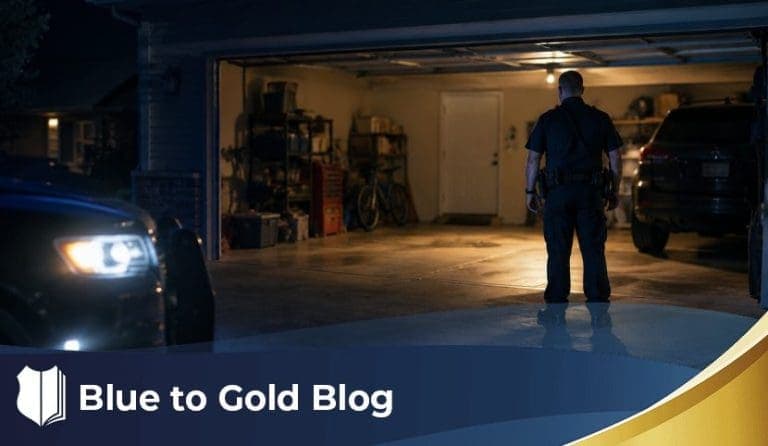
This is Roadside Chat #993, recorded February 26, 2026. The question comes from officers who run into this on patrol constantly: the garage door is standing wide open and you want to shut it for the homeowner. Here is why that is still a home entry.
Let’s talk about entering a garage in order to shut it because you believe that the homeowner has forgotten to close it. This is a very common scenario, very common situation that you guys face out there every single day, or you know, collectively around the nation. And let’s talk about it.
Does entering a garage to close it implicate the Fourth Amendment?
So let’s do some ground rules first, okay? The first ground rule is, would entering this home for this purpose even implicate the Fourth Amendment? Well, the answer is certainly yes, right?
So anytime that you enter a home, you need the acronym CREW. You need Consent, expressed or implied. You need a Recognized Exception like the emergency aid exception, hot pursuit, fresh pursuit. Or you need a Warrant.
Is there a good faith exception to warrantless searches and seizures?
Well, let’s talk about good faith. A lot of people say, “Well look, even if something goes sideways, even if I get into a use of force or I get sued on this, as long as I had good faith.” Which you certainly would, cuz that’s the epitome of what you’re doing here. You’re just simply trying to help. The only thing you’re trying to do here is help. You’re not trying to put people in prison, you’re not trying to find evidence of a crime, you’re simply trying to help. That is what a lot of cops consider good faith.
Well, there is no good faith exception to warrantless searches or seizures. In other words, it’s not what is in your heart, it’s what’s in your brain.
The courts require objective reasonableness when it comes to warrantless searches and seizures. And objective means that the facts of the case speak for themselves. Meaning, it’s not what’s in your heart, it’s what’s in your brain, and you can tell people, “Yes, this is what I knew at the time.” And they say, “Oh okay, I probably would have done the same thing, or I can understand why you did that. Yeah, with those facts, with the door ajar and pry marks and a rash of burglaries in the area, I actually would have thought that there was a potential ongoing burglary in that house, too.”
Versus subjective, which is, “You know what? My spidey senses said that something was going on here and that’s why I entered the home.”
So you need objective facts.
What is the de minimis doctrine?
Now let’s also talk about a doctrine called de minimis. De minimis is a doctrine the courts have recognized that essentially says that even though a search or seizure has occurred, even though the Fourth Amendment has been implicated, the actions of the officer are so small and really insignificant that they’re not going to be litigated in federal court.
I call this the spilled milk doctrine. Do you ever hear like, “Don’t cry over spilled milk”? Right? It’s just this, come on kid, why are you crying over spilled milk? You know, there’ll be more, right? And that’s what I call this doctrine.
Does the de minimis doctrine apply to homes?
However, does the de minimis doctrine apply to homes? And the answer is no. It cannot apply to homes.
Why? Because the home is the most protected thing, area, under the Fourth Amendment. When the Fourth Amendment says persons, houses, papers, and effects are protected and shall not be unreasonably searched or seized, well, there’s a hierarchy there. They didn’t put them in a hierarchy in the Fourth Amendment because the founding fathers were a little too busy, okay?
But the US Supreme Court has made it very, very clear that the entry into the home by the government is the chief evil. The unwarranted and unreasonable entry into the home is the chief evil that the Fourth Amendment is there to prevent. In other words, when the founding fathers sat down and started thinking about why they need a Fourth Amendment, the first thing in their head was to keep the king out of the home. Without the authority of law.
And recognized exceptions, though they exist, are scrutinously guarded against for abuse. Because though the Supreme Court has told us that we can enter homes without a warrant under certain situations, they are very critical though, so you want to make sure that you’re not abusing it.
Can you enter a home for a domestic violence call without more?
So for example, when it comes to domestic violence investigations, we have something called the emergency aid exception. And the Supreme Court has held in a recent case, in fact 2026, where they said that it’s based on objective reasons to believe that an emergency exists, right? That somebody needs help.
Well, we’ve had cases where the cops simply knew that a couple was arguing, right? They were yelling at each other. Like the neighbor called in and says, “Hey, it’s an apartment building, can you kind of like get these guys to shut up?” And the spouse will answer the door and be like, “Hey, you’re not coming in. Yeah, we’re yelling about money. We’ll lock it up. But you’re not coming to my house.”
And the cop thought that they had the authority just to enter because why? They were conducting a domestic violence investigation potentially, right? Cuz emotions run high and so forth. But there was no facts to believe there was physical violence. And the US Supreme, or not the US Supreme Court, but the local courts have held that that would be a violation. A particular case out of Nevada.
Do you have implied consent to close somebody’s garage?
So I’m just telling you that in order to enter a home, you need CREW. If you’re going to shut that garage, can you point to facts that you reasonably believe that you have their consent?
And there are certainly some scenarios that we can come up with that you would reasonably believe there’s implied consent to enter the garage and shut it on behalf of the homeowners. We can talk about those. They might be rare, but I can certainly think that there could be, okay?
Does the community caretaking exception apply to homes?
If you don’t have consent, now move on to RE. Do you have a Recognized Exception?
Well, there is no community caretaking exception applying to homes. So community caretaking is that whole mentality of, “Hey, I just want to help. I’m not here to send people to prison. I’m not here to, you know, look for plain view evidence in the garage. I simply just want to help and try to prevent this person becoming the victim of theft, burglary, and so forth.”
Well, we know from Caniglia v. Strom that community caretaking as a doctrine does not apply to homes. So I’m sorry, even though that’s what most cases would have looked to prior to Strom, they would have said, “Hey, the officer had community caretaking.” We know that that does not apply.
And we also know from the case law that the doctrine is actually called the emergency aid exception, which requires exigency, some kind of emergency, and an urgency. Your wanting to help is not good enough.
And that puts us in a little bit of a predicament, doesn’t it? Because we are police officers and we want to help. So we say to ourselves, “Man, if I don’t go in and I leave this neighborhood, they become the victim of a crime.” And I say, that’s the cost of freedom. Because we also have a Fourth Amendment telling us that we can’t go in just to help people make better life choices and not be cognizant of their situation, surroundings and so forth, and close the garage.
But you got to weigh it out.
What would happen if the de minimis doctrine applied to front doors?
Okay, and de minimis just doesn’t work. If de minimis was a doctrine to work here, well then try this. If de minimis works with the garage case, then it also works for this case I’m about to tell you.
Imagine a police officer walking down the street at 2:00 in the afternoon. He goes up to houses and he jiggles the door handle looking for an unlocked door. And after the third jiggling, the door opens. The front door opens. He walks right in. He sees a family on a couch watching TV. They turn to him and they say, “What are you doing here, officer?” And the officer kind of smiles and says, “Well, I’m testing out this new doctrine. It’s called de minimis. If I don’t stay in your house too long and I leave, then it’s de minimis and you can’t sue me. So I’m out of here.”
And this all takes like seconds, right? In fact, it’s less time than the garage case.
And then the family, after the guy leaves, they’re like, “What the heck just happened here?” So they call a lawyer. They have it all on film cuz they have, you know, cameras in the house, security cameras. And the lawyer looks at the case and says, “I’m going to take your case.”
And then the cop goes to the trial and he says, “My defense is de minimis. Meaning, you can’t sue me because my entry is so small and insignificant that nobody got hurt, it didn’t mean anything, and so forth.”
How do you think that’s going to work out for that cop? Do you think that the court is going to throw that case out because it’s de minimis?
Look, if you think it works for the garage case, it has to work for this case. Because with de minimis, what you’re saying is regardless of what your intent is, the actual intrusion itself is so insignificant, it will not be litigated. Well, you know what’s going to happen in that case.
Does good faith protect you if you get sued?
But Anthony, that’s different because that cop had bad faith. Well, I already told you, your faith does not matter when it comes to warrantless searches and seizures. Whether it’s bad faith or good faith, it doesn’t matter.
Good faith and bad faith apply to internal investigations. It applies to juries giving it to you when you actually violate people’s rights because you had bad faith. It applies to your chief whether or not he wants to fire you or not, because he doesn’t want bad faith officers on his team.
But there have been plenty of officers who have violated the Fourth Amendment, had good faith, and still paid money. But they often keep their job because the chief knows that we can fix a person like that. We can train him or her.
So good faith doesn’t apply to the garage case. It doesn’t exist. There is no case out there that says that you can enter a home without CREW and as long as it’s not a long period of time, it will be de minimis. The entry itself is not de minimis. It absolutely implicates the Fourth Amendment in a significant way.
What is the worst case scenario when you step into an open garage?
And all I got to tell you is this. These are very tough calls, okay? And I’m not even here to tell you what to do. I don’t even know, you have to tell me what you’re looking at, you know, and so forth. I think there are plenty of situations where you could probably justify CREW. But I would just hate to see an officer who does this, is not thinking about the legal issues.
The homeowner did not hear the loud knocking. The officer tried to do their best to get him up. Did not hear the loud knocking, but once the dog starts growling, whatever, the homeowner got up, hears something going on. I have lots of security cameras at my house and I get like motion sensors, you know, like hey, there’s somebody at your front door, there’s somebody in your backyard, whatever. And so the homeowner gets this motion alarm. It doesn’t say cop, right? It says there’s somebody in your garage.
He grabs the Colt Python. He’s old school, right? The homeowner’s old school. He grabs the Colt Python. The .44, you know what I mean? Like Dirty Harry level. And opens the garage door to see if anybody’s trying to burglarize his house. He doesn’t know his garage is open. In fact, he would have liked it to have been closed to begin with, but he fell asleep. Too much natty light.
And he opens up the garage and he sees a shadowy figure who happens to be that police officer just trying to help out. And he starts leveling the firearm towards that shadowy figure and he’s about to say, “Who goes there?” But it wasn’t enough time. The cop shoots him. And the cop goes to federal court for an OIS.
And he says, “Your honor, I had good faith. I didn’t have consent, express or implied. I don’t think I had that. I didn’t have any emergency, but I did have good faith.”
I don’t know. I think that we’re going to have a problem.
What should you take away from this?
And so all I can tell you to take from this video is not whether or not you should do it. I’m here to tell you to think about what you’re doing. If you’re entering the garage, it requires CREW. If you don’t have CREW, you have a violation. What happens from there is out of my hands. That’s where the courts assess qualified immunity and so forth, okay?
All right. Good conversation, but the most important thing to take away from it is to think about what you’re doing, because this is 2026 and beyond. Courts aren’t playing around. You either have it or you don’t.
The short version
- Anytime that you enter a home, you need the acronym CREW. You need Consent, expressed or implied. You need a Recognized Exception like the emergency aid exception, hot pursuit, fresh pursuit. Or you need a Warrant.
- There is no good faith exception to warrantless searches or seizures. It’s not what is in your heart, it’s what’s in your brain.
- Does the de minimis doctrine apply to homes? The answer is no. It cannot apply to homes.
- We know from Caniglia v. Strom that community caretaking as a doctrine does not apply to homes.
- The doctrine is actually called the emergency aid exception, which requires exigency, some kind of emergency, and an urgency. Your wanting to help is not good enough.
- If you think it works for the garage case, it has to work for this case. A cop jiggles a front door handle, the door opens, he walks right in for a few seconds and leaves. You know what’s going to happen in that case.
- There is no case out there that says that you can enter a home without CREW and as long as it’s not a long period of time, it will be de minimis.
- There are plenty of situations where you could probably justify CREW. I would just hate to see an officer who does this, is not thinking about the legal issues.
- This is 2026 and beyond. Courts aren’t playing around. You either have it or you don’t.
My friends, keep the questions coming. If you like what we’re doing here at Blue to Gold, attend our classes. Of course, share these webinars with people and these roadside chats and so forth. And until next time, my friends, make good case law.
Source: Roadside Chat EP#993, “De Minimis Entry: Can an Officer Close an Open Garage Without CREW?” (watch on YouTube).
This article is for training purposes only. It is not legal advice. Your state law, your agency policy, and your local case law may be more restrictive. Check with your agency legal advisor or prosecutor.
Related from Blue to Gold
- Community Caretaking and Red Flag Laws
- Case v. Montana: The U.S. Supreme Court Clarifies the Legal Standard for Warrantless Home Entry to Render Emergency Aid
- Major Case!!! Caniglia v. Strom Community Caretaking and Red Flag Laws
This article is legal training, not legal advice. Check your state law and your agency policy, because both can be more restrictive than the Fourth Amendment.